
Explainer · Heating and oil
How much carbon can a heat pump avoid?
Heat pumps are gaining market share, but shipment counts do not measure climate impact. A national building-stock study estimates the size of the opportunity—and why it varies from home to home.
Average annual greenhouse-gas savings per dwelling
per dwelling each year
If every suitable US home switched immediately
Modeled potential: full, immediate adoption across five future-grid scenarios. These are operating-emissions estimates, not observed 2026 reductions.
View chart data
| Measure | Modeled range |
|---|---|
| Per dwelling | 2.5–4.4 metric tons CO₂e/year |
| US residential total | 330–590 million metric tons CO₂e/year |
| 2020 residential-sector emissions | 36–64% |
| Total US emissions | 5–9% |
Reviewed findings and study scope (JSON)
Source: NREL ResStock study, Wilson et al. (2024). Dataset and checksums.
Download the share chart (PNG)
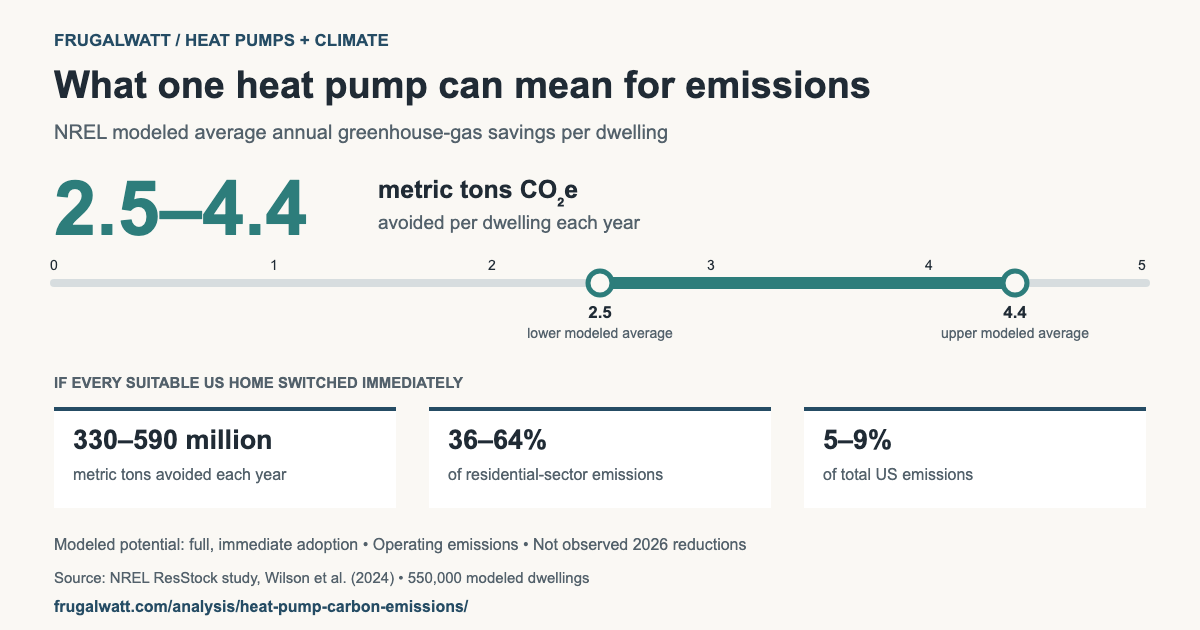
NREL modeled 550,000 statistically representative US dwellings and found average greenhouse-gas savings of 2.5–4.4 metric tons of CO₂e per dwelling each year. Savings were positive in every state and every scenario studied. That is modeled potential under full adoption, not a measurement of reductions already achieved.
The national result
The study tested six air-source heat-pump scenarios across five projections for how the electric grid could change from 2022 through 2038. It modeled about 550,000 representative dwellings, standing in for roughly 113 million occupied US homes.
| Measure | Modeled range |
|---|---|
| Average annual savings per dwelling | 2.5–4.4 metric tons CO₂e |
| Annual US residential savings | 330–590 million metric tons CO₂e |
| Reduction from 2020 residential-sector emissions | 36–64% |
| Reduction from total US emissions | 5–9% |
The national total is large: in the study's full-adoption scenario, residential heat pumps cut the equivalent of 5–9% of economy-wide US emissions. That is a technical potential, not a forecast that every home will switch immediately.
Why the answer is a range
A heat pump moves heat rather than creating it by burning fuel. Its climate benefit depends on how efficiently it works, the electricity supplying it, the amount of heating the home needs, and the system it replaces.
NREL found the largest reductions when a heat pump replaced fuel oil. The smallest reductions came in homes that were already heated with electricity. Colder climates generally produced larger savings per household because they had more heating energy to displace. Adding insulation increased energy savings and changed the equipment size and cost as well.
The grid matters too. A heat pump uses electricity, so its operating emissions fall as electricity generation gets cleaner. The study did not freeze the grid at one year's average; it evaluated five grid trajectories across the equipment's modeled 16-year life.
Why shipments cannot tell us the carbon reduction so far
AHRI manufacturer data show heat pumps outshipping gas furnaces, but those units cannot be multiplied by 2.5–4.4 metric tons to produce a credible national total. Shipments include distributor inventory and commercial equipment. One home can use multiple outdoor units, and a shipped heat pump may replace an air conditioner or supplement an existing furnace instead of replacing fossil heat.
The FrugalWatt shipment analysis measures market movement. This analysis measures modeled climate potential. Estimating reductions already achieved would require installations, the equipment replaced, regional performance and the electricity used during the same hours.
“Avoided emissions” is more accurate than “offset”
An offset usually means compensating for emissions somewhere else, such as buying a credit. A heat pump can reduce the emissions created by heating the home itself. The cleaner phrase is emissions avoided.
That distinction also keeps the claim tied to operation. Manufacturing equipment, refrigerant leakage and installation materials can add lifecycle emissions. This article reports the operating-energy result modeled in the NREL study; it is not a full product carbon footprint.
What this means for a homeowner
The climate case is strongest when a well-sized, efficient heat pump replaces oil, propane or inefficient resistance heat and performs most of the winter heating. Replacing a high-efficiency gas furnace can still reduce emissions, but the size of the reduction depends more heavily on local electricity and cold-weather performance.
Carbon and cost are separate questions. A project can cut emissions while raising a bill where electricity is expensive relative to gas. Use the heat pump versus oil calculator for operating cost, then treat this study's range as national climate context rather than a promise for one address.
What this data does not tell you
- Potential, not progress to date. The study applies heat-pump upgrades to almost the entire modeled housing stock. It does not report how many systems have actually been installed or the emissions already avoided.
- Average, not a household estimate. The 2.5–4.4 metric-ton range is an average across modeled dwellings and scenarios. A specific home can fall outside it.
- Operating emissions. The comparison covers modeled household energy use and associated grid and on-site emissions. It is not a complete lifecycle inventory of manufacturing, construction and refrigerant leakage.
- Grid projections. Results depend on five modeled 2022–2038 electricity-grid scenarios. Actual generation and the timing of heating demand will differ.
Methodology and sources
FrugalWatt transcribed the four published national ranges from Wilson et al. (2024), “Heat pumps for all?”, and checked each against the Results section on journal page 1003. The study used ResStock and EnergyPlus to simulate about 550,000 statistically representative dwellings under six air-source heat-pump scenarios and a reference equipment-replacement case. Greenhouse-gas results were evaluated across five electricity-grid scenarios and levelized over a 16-year equipment life. FrugalWatt did not recalculate the dwelling-level model or combine its results with shipment totals. The reviewed extract, study links, scope and paper locations are preserved in the downloadable snapshot.
- NREL: Heat pumps for all? Distributions of the costs and benefits of residential air-source heat pumps in the United States
- Joule: peer-reviewed study and methodology
- Zenodo: public results dataset, version 2023.1 (CC BY 4.0)
- US Department of Energy: ResStock residential building-stock analysis
Dataset version, source release and checksums
Dataset version nrel-heat-pump-climate-9a65970a9f660a86 · Source release Wilson et al., Joule 8 (2024) · Retrieved September 23, 2026. Download the snapshot manifest and file checksums. The observation or model period is separate from the release date and retrieval date. How we verify.
More analysis
Related tools
Drafted with AI assistance from FrugalWatt's data pipeline. Figures use the cited NREL ResStock study snapshot; No interviews were conducted and no professional review is claimed. Editorial policy · Subscribe via RSS.